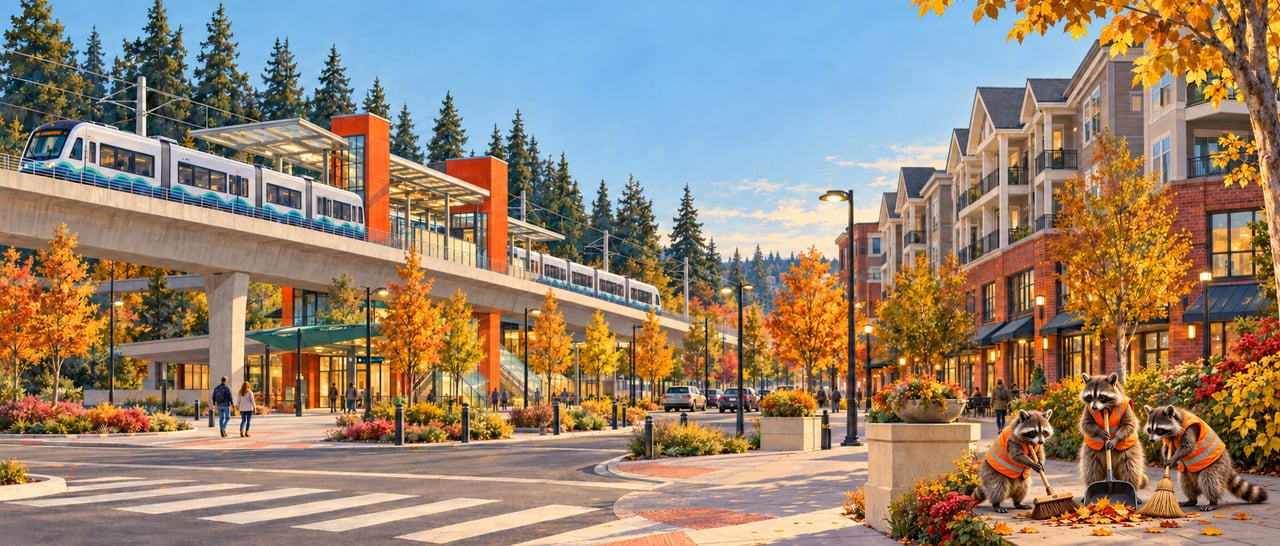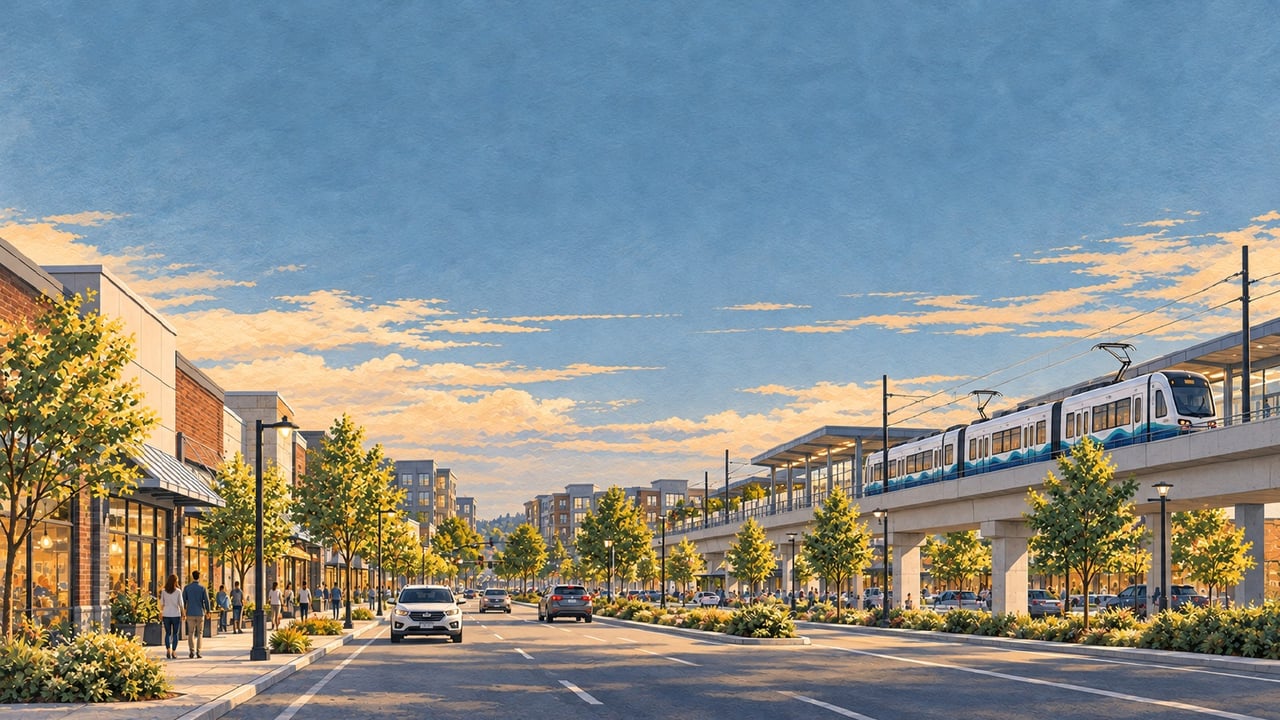
Stand at the Lynnwood City Center Station platform today and the train works exactly as advertised. Walk two minutes west, though, and you're looking at a Grocery Outlet, a shuttered furniture store, and acres of surface parking that were supposed to become a 19-acre neighborhood of shops, offices, and apartments years ago. That gap between what the train delivers and what the blocks around it deliver is the part buyers comparing Lynnwood to Shoreline, Edmonds, or Mountlake Terrace need to understand before they pay a premium for proximity to a station that hasn't finished becoming a place yet.
The project meant to close that gap is called Northline Village, and its own timeline just slipped in public, on the record, four days before this was written.
The delay nobody's marketing
The Lynnwood City Council approved a 15-year development agreement for Northline Village back in 2019. The plan called for roughly 1,370 housing units, 500,000 square feet of office space, half that again in retail, and two new parks, all built on the strip-mall lots directly across from the station. Light rail arrived in August 2024. Northline Village did not follow it.
According to reporting from HeraldNet published September 12, 2026, the project is still in its earliest stages, less than seven years into that 15-year agreement, because construction costs have made the first phase difficult to pencil out. Karl Almgren, Lynnwood's community planning manager, put it plainly: the site needs sewer, water, power, telecommunications, and roadway work before anything vertical can go up, and that infrastructure is a large upfront cost with no revenue attached to it yet. Merlone Geier Partners, the developer that has held the land since 2014, declined to comment beyond saying the team would reach out if appropriate.
That's not a scandal. Big transit-oriented developments run on decade-long clocks everywhere in this region. But it does mean the "walkable downtown" that shows up in marketing language about Lynnwood's station area is still mostly a rendering, not a delivered amenity, and buyers pricing in that amenity today are pricing in a promise with a moving delivery date.
What's actually opening while the anchor project waits
The station area isn't frozen. It's just building something different than the flagship pitch. Nearby, a few projects are further along:
- Kinect@Lynnwood, a 239-unit building with 48 affordable units, has been open near the station for several years.
- Enzo, a market-rate project of 316 units, was already leasing as of a March 2026 city council briefing on Lynnwood's housing pipeline.
- Polaris at Lynnwood, a 294-unit affordable apartment building proposed by Spokane-based developer Inland Group, is redeveloping a former park-and-ride and Tesla charging site less than half a mile from the transit center. Its public comment period closed in June 2026.
- Housing Hope's planned 167-unit affordable complex sits on a 2.4-acre lot Sound Transit sold for a nominal $167,000 against a $4.8 million appraisal. The plan includes a medical-dental clinic, child care, a job-training cafe called Kindred Kitchen, and the daylighting of a buried tributary of Scriber Creek that an environmental report nicknamed Park-N-Ride Creek.
Notice the pattern. What's actually breaking ground around the station skews toward income-restricted and mid-size apartment buildings, not the mixed office-retail-entertainment district that anchors the original pitch. Sarah Cho, Lynnwood's City Center program manager, told HeraldNet she expects the area to take true form as a destination over the next five to ten years. That's the city's own planner talking in half-decade increments, not the language of a neighborhood that's already arrived.
The blocks that are actually pricing at the top
Here's where the story gets interesting for anyone shopping on price. In July 2026, Lynnwood's citywide median sale price hit $779,990, up about 7.6% from the same month a year earlier. But that median hides two very different products. Single-family homes in established neighborhoods like Alderwood and Lynndale, both a short drive from the station rather than a walk, ranged from $750,000 to $850,000. Townhomes and condos near City Center, the product actually delivering right now within walking distance of the platform, started between $450,000 and $650,000.
In other words, the homes commanding the top of the market aren't the ones closest to the train. They're the established single-family blocks farther out, where buyers are paying for finished neighborhoods and larger lots rather than a five-minute walk to a station surrounded by construction fencing. The station-area product pulls the citywide median down, not up, because right now that product is disproportionately compact or income-restricted rather than move-up housing.
That same July 2026 snapshot showed homes spending a median of 18 days on market, sellers receiving about 97.6% of original asking price, and total inventory up roughly 43.5% year over year to 198 active listings, with new listings running 22.2% higher than a year prior. More supply hitting the market at the same time closed sales rose 16.4% year over year is not a market cooling off. It's a market absorbing more choice without losing its grip on pricing, which matters for anyone assuming extra inventory automatically means room to negotiate.
Read every "Lynnwood is up" or "Lynnwood is down" headline with one question
If you've already searched Lynnwood home values, you've probably seen wildly different numbers depending on which site you landed on. One estimate for June 2026 put citywide values down about 7% year over year. A different three-month window ending in May 2026 showed a median sale price near $740,000, down roughly 1%. A September 2026 snapshot showed list prices down 3 to 4% from the year before. None of these directly contradicts the July 2026 sale-price figure showing a 7.6% gain.
They're not lying to each other. They're measuring different baskets. Some track asking price, others track closed sale price, others model an estimated value across the entire housing stock. Some look at a single month, others average three. And Lynnwood right now is genuinely a mix of brand-new condos, income-restricted apartments, and 60-year-old single-family homes on quarter-acre lots, all folded into one citywide number. Whichever mix of those properties happened to close in a given window will swing the median even if nothing about the underlying market changed. The lesson isn't to trust one source over another. It's to stop trusting any single citywide median as a stand-in for what your specific target block is doing.
Don't price in a station that's over a decade away
Some listings will lean on Lynnwood's next light rail chapter, the future West Alderwood station near Alderwood Mall, as part of the pitch for property in that area. Worth knowing the actual timeline before that argument moves your offer. The Everett Link Extension, which would add West Alderwood and five other stations north of Lynnwood, was approved by voters as part of the 2016 ST3 measure with an original 2021 cost estimate of $6.6 billion. Sound Transit is now confronting a system-wide funding gap of roughly $34.5 billion over the next 20 years, which pushed the board to adopt an updated System Plan in May 2026. The Draft Environmental Impact Statement for Everett Link is expected in fall 2026, construction could begin around 2030 at the earliest, and the agency's own projections put a full opening between 2037 and 2041, with at least one scenario under consideration that stops short of connecting all the way into downtown Everett. The West Alderwood station's preferred design, an elevated platform on the west side of Alderwood Mall, was only recently narrowed down, and no dedicated parking is currently planned for it.
That's a real project with real momentum, but it's optionality measured in decades, not a near-term catalyst. Treat it accordingly.
What this means if you're shopping Lynnwood right now
A few practical habits make the difference between buying the neighborhood that exists and buying the one in the rendering:
- Ask what's been issued a certificate of occupancy within actual walking distance, not what's been announced or proposed.
- Compare like to like. A station-area condo and an Alderwood single-family home are different products serving different buyers, not two data points on the same curve.
- Treat any future station, West Alderwood included, as a decade-plus horizon rather than something that should move your offer today.
- Pull sold comps for the specific block you're considering rather than leaning on a citywide median that blends condos, income-restricted units, and established single-family homes into one number.
Lynnwood is genuinely changing. The station is real, the ridership is real, and the city's own housing pipeline shows steady multifamily production even with one anchor project delayed. The point isn't to wait for Northline Village to finish before buying here. It's to know exactly which part of that story is built, which part is funded, and which part is still a rendering, so the price you agree to reflects the neighborhood you're actually getting.
If you're weighing a specific block in Lynnwood against Edmonds, Shoreline, or Mountlake Terrace, Team NSRG can walk the comps with you street by street and separate what's delivered from what's still on the drawing board. Schedule a consultation and we'll help you read the market with the same eye we'd use if it were our own offer.